


The Prefrontal Cortex of the Enterprise
Why Leadership — Not Frameworks — Determines Transformation Success

Most enterprise transformations don’t fail for the reasons we like to cite.
It’s not usually the framework. It’s not the teams. And it’s rarely the tooling.
The uncomfortable truth is this: transformation fails because the leadership function cannot keep up with the cognitive demands of the system it is trying to change.
The Hypothesis
Across industries, organizations have become highly competent at execution. We know how to structure teams, implement Agile frameworks, manage portfolios, and deliver technology at scale. Yet transformation outcomes remain inconsistent. A working hypothesis emerges:
Most enterprise transformations fail not due to poor frameworks or weak teams, but because the executive function of the organization - leadership’s capacity for decision, prioritization, and restraint - is insufficient for the complexity it faces.
This is not a criticism of leaders. It is a recognition of how the role has evolved.
Leadership: Role vs. Function
Leadership is often treated as a role - a position in a hierarchy.
But in practice, it behaves more like a function: a set of capabilities that must exist somewhere in the system.
Across decades of research, definitions of leadership converge on a few core themes:
Setting direction
Influencing others
Mobilizing collective action
At its best, leadership becomes the disciplined stewardship of long-term outcomes through focus, alignment, and execution.
But here’s the problem: no one really teaches executives how to perform this function at the level required today. There is no “residency” for CEOs. No structured training in decision-making under uncertainty, prioritization under constraint, or the discipline of stopping work.
Most leaders are promoted for technical competence and then expected to operate at a system level — often learning through high-stakes trial and error.
The Hidden Bottleneck
Modern enterprises operate in environments defined by:
Rapid feedback loops
Constant ambiguity
Expanding choice sets
Increasing decision velocity
Frameworks like SAFe increase transparency and coordination - which is valuable.
But they also increase cognitive load. They expose a critical constraint: the leadership system.
When executive function is insufficient, predictable patterns emerge:
No clear direction - Drift
No prioritization - Overload
No inhibitory control - Nothing stops
Poor sense-making - Confusion
No integration - Silos persist
Slow decisions - Paralysis
Emotional reactivity - Instability
In other words, the system becomes active - but not effective.
A Useful Analogy: The Enterprise Brain
Neuroscience offers a helpful lens. The prefrontal cortex is responsible for executive function - the capabilities that enable complex decision-making:
Goal selection
Prioritization
Inhibitory control
Cognitive flexibility
Working memory
Judgment under uncertainty
Now consider the enterprise as a system:
Motor system - Teams executing work
Sensory system - Data, metrics, customer feedback
Prefrontal cortex - Leadership/executive function
Teams can execute. Data can inform. But only leadership decides where the system goes - and what it stops doing.
When the “prefrontal cortex” of the enterprise is weak, the organization doesn’t fail from lack of effort. It fails from lack of coherence.
Evidence in Practice: Microsoft Under Nadella
In 2014, Microsoft was profitable but stagnating - culturally fragmented and strategically constrained.
Satya Nadella made three decisive moves:
Culture shift - from “know-it-all” to “learn-it-all”
Strategic focus - cloud-first
Leadership alignment - changing key roles. As Jim Collins might say re his "who not what first" findings: get the right people on the bus, wrong people off the bus and right people in rights seats.
This wasn’t a framework change. It was a leadership reset.
The result:
Market value grew from ~$300B to over $2.5 trillion
Azure became a dominant cloud platform
Microsoft repositioned itself as an innovative, adaptive enterprise
Nadella didn’t optimize the motor system. He rebuilt the prefrontal cortex.
What This Means for Agile Leaders
Enterprise agility distributes decision-making - but it assumes something critical:
That someone, somewhere, can:
Prioritize effectively
Stop work when necessary
Integrate across silos
Make decisions under uncertainty
Frameworks don’t fail.
Executive function does.
The Real Leadership Gap
Most leadership development still focuses on:
Communication
Behaviour
Presence
All important - but incomplete.
What leaders increasingly need is capability in:
Decision hygiene
Trade-off discipline
Attention management
Judgment under uncertainty
The ability to say “no”
In short, leaders must develop the cognitive capabilities required to operate complex systems - not just the interpersonal skills to manage people.
A Final Thought
Agile frameworks are exceptionally good at improving how work gets done.
But transformation success depends on something deeper:
Frameworks organize work. Leadership makes the system intelligent.
If the prefrontal cortex of the enterprise is underdeveloped, no amount of process optimization will compensate. The real work of transformation, then, is not just redesigning how organizations execute - but upgrading how they think.
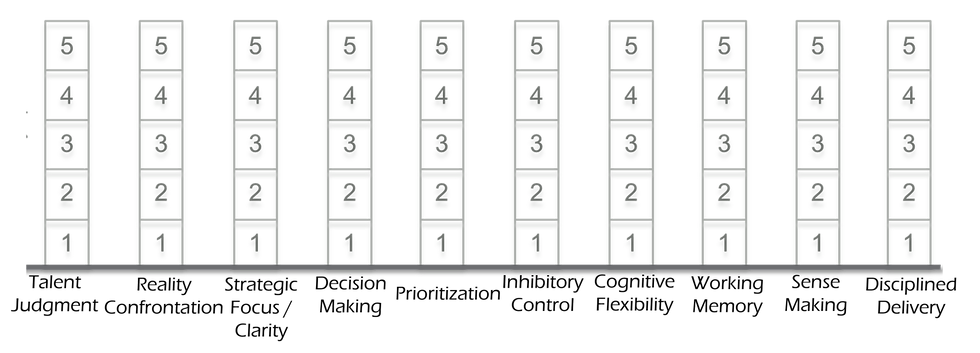
Leadership Diagnostic - Is your "prefrontal Cortex" fit for purpose?
If leadership is the executive function of the enterprise, we should be able to assess it explicitly. Below is a simple diagnostic you can apply to your own organization or leadership team.
Rate each capability on a scale of 1–5:
(1 = weak / inconsistent, 5 = strong / disciplined)
If you require more details to facilitate a short workshop on this innovative approach, reach out here.
Comments